Pages

Friday, July 22, 2011

Queen Kong

You may remember a post from early in my blog, when I mentioned our (relatively) new Boston Terrier, Darcy.  I referred to her as a volatile dog, but didn't give any details, so I thought I might take a moment to quantify her explosive nature.  She enjoys chew toys very much, but we've found that most toys can be destroyed within seconds.  Squeaking weasels have been eviscerated, and bones have been chewed into shreds.  The one type that has stood up to her has been the Kong, a chew toy inspired by a part of the suspension of a VW van.  It's shaped as a conical tube, which she spends hours a day crushing flat, only to have it spring back.  I've tried this myself (with my hands, that is) and it's impressively difficult to do, so I started wondering how many calories she was burning with this jaw exercise.

The only scale we had around was a small kitchen one that only went up to 5 kg, but if we assume the Kong follows Hooke's Law (the usual approximation for a spring) we can figure out the energy involved.
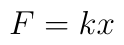
Measuring the larger opening closest to the camera, the difference between the uncompressed Kong (left), and the Kong compressed by 4.2 kg (right) is 0.26 cm.  Hooke's Law gives the force exerted by a spring compressed a distance x as
where k is a constant that characterizes the strength of the spring.  Using the information we have, k = 16,000 kg/s^2.  The energy required to compress a Hooke's Law spring is
so squeezing the Kong flat (3.61 cm) requires 10.4 J, or 0.0025 Calories.  It may not seem like much, but that's about equal to the energy involved in one arm-curl of an 8 pound weight.  Also keep in mind that Darcy is only 18 pounds herself, so imagine lifting half your own weight.  I should also note that, if anything, this is an underestimate, since it feels to me as if it gets more difficult to compress as it flattens.  Further evidence that Darcy is not a dog to cross...

Thursday, July 21, 2011

Raise a Glass

Last night, we drank champagne to celebrate the end of my treatment.  The flutes we used got me thinking about the old trick of running a wet finger around the rim of a wine glass to make a tone.  I wondered whether it would be possible to predict the frequency of the tone based on the shape of the glass.  I tried it out on three different glasses:
According to Wikipedia, the resonant frequency of a cone (which we'll approximate the leftmost two glasses as) is the same as that of an open cylinder, which is given by
where n is any positive integer, v is the speed of sound, L is the length of the tube (in this case the height of the inside of the glass), and d is the diameter of the tube (in this case the diameter halfway up the glass).  The rightmost glass we'll approximate as a closed cylinder, whose resonant frequency is
I tabulated the results of these equations, and the frequencies I actually measured below:

Glass Small Cone Large Cone Flute
n 1 1 3
L (cm) 4.62 7.61 11.3
d (cm) 7.23 7.5 5.49
Theoretical Freq. (Hz) 1914.49 1416.18 1906.12
Measured Freq. (Hz) 1850.3 1548.9 1704.7
Percent Error 3.47 8.57 11.82
I'm impressed by how well the results fit the theory, given all the approximations involved.  Even a perfect cone or cylinder would not be exactly described by the equations above, but it's nice to see that they work well on even an imperfect example.

Wednesday, July 20, 2011

The Deed is Done

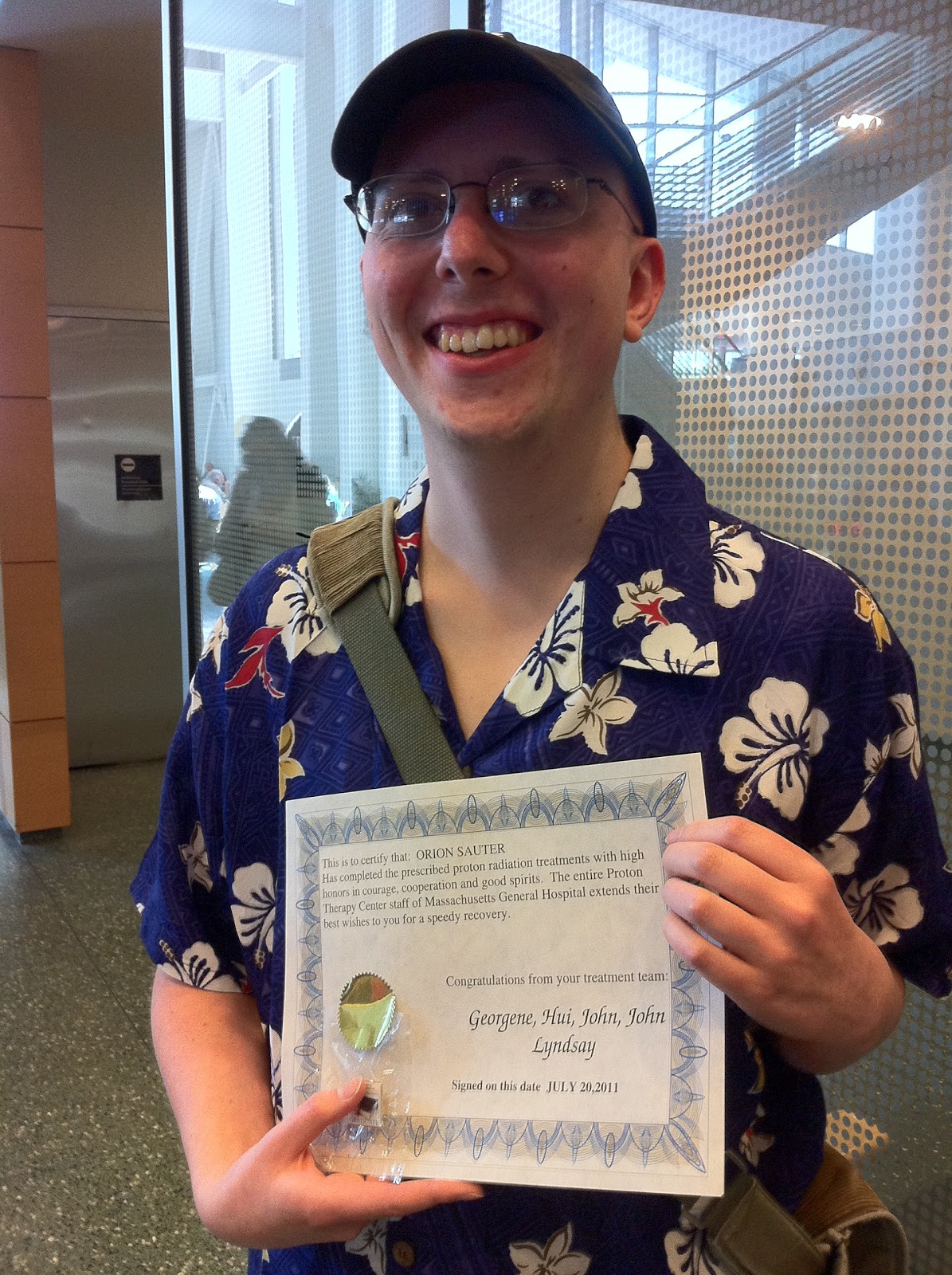
Today was the last day of my proton radiation therapy.  This marks the end of my cancer treatment, though I still have a few check-ups and a lifetime of periodic MRIs ahead of me.  I couldn't have made it this far without the incredible support of all my friends and family, but there are a few people that I think deserve special recognition and thanks:
  • My optometrist, Brian Wadman, who first noticed my swollen optic nerve and sent me for the MRI that revealed my tumor.
  • My neurosurgeon, Ziv Williams, who evidently heeded my warning that my brain is about all I have going for me.
  • My oncologist, David Ebb, who planned my treatment and kept a watchful eye over me throughout the ordeal.
  • My nurse, Patti Scott, who would smile and laugh with me as she drew tube after tube of blood samples from my chest-port.
  • My radiation oncologist, Shannon MacDonald, who was a match for my geekiness as she explained the inner workings of the MGH cyclotron.
  • My mother Sally, who kept at work during this difficult time, providing the top-notch health insurance that allowed me to be treated.
  • Most of all, my father Steve, who has been my roommate, nurse, chef, personal trainer, secretary, biographer, chauffeur, and friend during the worst 7 months of my life so far.