Pages

Saturday, June 24, 2023

Hail! Hail! To Michigan!

[Title from the University of Michigan fight song, which Steve couldn't stop singing when I was accepted to the graduate program.]

A couple of weeks ago, we had a sudden hailstorm while I was cooking dinner, and the kitchen skylight made some incredible (and alarming) sounds:

I started to wonder whether I was in danger of being showered with glass, and while the skylight (and I) survived the storm, I thought I'd take a look at what the chances were for future shattering.

Hailstones can form in tall thunderclouds with lots of air movement, where water drops can rise into cooler regions and freeze, then fall partway to collect more water. This repeats several times before the hail falls. If it falls far enough, it will reach terminal velocity, the speed at which the force from gravity pulling down balances the air resistance slowing it down:

where m is the mass, g the gravitational acceleration, ρ is the density of air, A is the cross-sectional area of the hailstone, and Cd the drag coefficient, which depends on the shape of the object. Since I'm a physicist, I'll assume the stones are spheres with uniform density. Then we can express the mass and area in terms of the radius of the hailstone, and use the tabulated value for the drag coefficient:

Plugging these into the velocity equation above, we find
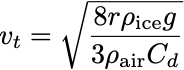
I wanted to check whether this was reasonable, so I found a paper from the University of Wyoming with this plot:

Figure 1

If we plot our function over the same range of diameters, the velocities match incredibly well, given the simplifying assumptions we made:

Now that the velocity is settled, we can look at how much energy the hailstones carry. Kinetic energy uses both the velocity and mass to give

So now the question becomes, at what point is this large enough to break glass? Lucky for us, a student at the CUNY College of Criminal Justice wrote their thesis on shooting BBs at windows!

Table 2

This gives the minimum energy for damage as around 2 kJ. We can plot energy vs hail size and see how big the stones have to get:

According to this, the glass will start to be damaged at a diameter of about 140 mm, or the size of a softball! At that point, I think there may be more to worry about than just the skylight.

Sunday, June 18, 2023

Scanning the Skies

Last week, the LIGO-Virgo-Kagra Collaboration held a town hall with electromagnetic observers to discuss the status of the ongoing 4th observing run. Among the presenters were representatives of the Swift Burst Alert Telescope, or BAT, a satellite designed to detect gamma rays like the ones released by the binary neutron star collision LIGO picked up in 2017. They caught my attention with the name for their analysis tool for BAT: GUANO, and I'm a sucker for Dr. Strangelove references. What I started thinking about though, was what would be the best strategy for observing the whole sky, given that the satellite can only make detections in a small patch at any given time.

The theory is to use the same type of effect I discussed several years ago, where a spinning object tumbles in unexpected ways, thanks to Euler's equation:

According to this, if the angular velocity ω is not aligned with the symmetries of the object, represented by I, the velocity will change, even if the torque τ is zero. While it bears little resemblance to BAT, I decided to see what happens if I take a simple cylinder, and spin it off-axis. The plot below shows the cylinder in 3D, with a line marking a constant point on the outside to show rolling motion (though a plotting quirk makes it hard to see sometimes). Under that is a skymap of the parts of the sky the telescope has passed over.

You can see the color rescales to account for the telescope retracing areas it's seen before. I wondered though whether I could pick a particular rotational velocity that would allow the telescope to scan the whole sky without ever needing to apply a torque, which would require fuel. After failing to get an optimizer to figure out the best choice, I just tried a bunch of values, and settled on this one, which makes a nice latticework:

Of course, you can imagine the nauseating sort of view this pattern will give you! If this were actually the way the satellite operated, it would need a lot of post-processing, but the whole point of LIGO's public alerts is that detectors like this one can rapidly refocus on possible events, so I don't expect Swift to adopt this technique anytime soon.

Saturday, June 10, 2023

Maybe Avoid the "Nuke" Idiom

This week I saw the news that Caltech had completed a proof-of-concept mission demonstrating power transfer from space using microwaves. I was instantly transported to my childhood playing SimCity 2000, which offered a microwave solar power plant for more advanced cities. I hadn't realized such a plan was actually feasible, but it's been considered since the 90s. The main obstacle has been cost, since the project requires many solar panels, all delivered to space. With the price of solar panels going down though, it's come back into the realm of possibility. However, I was curious about the possible risks of such a system, since SimCity (a credible source if ever there was one) suggested the possibility of accidental fires set by the system.

Before getting into that though, let's discuss how these systems work. To get the maximum amount of power from a solar cell, we want it to be constantly illuminated, but for a panel on Earth this isn't possible, since it spends roughly half its time in night. To get around this, we could put the panel is space, where it can always face the Sun, but now we have a new problem: How do we get the power it produces back to Earth? The simplest solution is to send back electromagnetic waves, but why choose microwaves? To answer that, we need to look at the absorption spectrum of the Earth's atmosphere (click to enlarge):

Wikipedia

We're interested in the regions with low absorption, since we want our beam to go through the atmosphere to a receiver on the surface. Microwaves have a wavelength around 12 cm, which falls neatly in the dip on the right side of the plot.

Since we want to keep the beam fixed on a single receiving station, we want the satellite to be in geostationary orbit, which requires a distance of 36,000 km. This page gives the size of the receiving antenna as about 3 km in diameter, which corresponds to an angle of about 5 millidegrees from the spacecraft. That page also gives the total power transfer as about 1 GW. Given how tiny that angle is, it's easy to imagine the beam being knocked off center, so how much damage could it do?

With the numbers above, the spot would have a power density of 141 W/m^2. For thermal radiation, this is well below the level that can burn you. Of course, these are microwaves, commonly used for cooking, so how does it compare to what you have in your home? A typical microwave oven has an area of around 20" x 24", and puts out around 1000 W, which comes to 3200 W/m^2, almost 23 times what our beam is sending!

So you'd be able to take a nap on the receiving dish without getting cooked, but your WiFi uses the same 2.4 GHz frequency that this system does, so would you be able to read this blog? I found a paper discussing the power density from WiFi base stations as a function of distance:

Figure 9

Note the scale is in milliwatts per square meter, meaning this is several orders of magnitude below the beam's power. Even this weak microwave signal can knock out your wifi!

It seems my childhood fear (or fascination) of fiery beams from the heavens was unfounded, but if they do build one of these, it has the potential to knock out your internet nearby...