Pages

Saturday, October 3, 2020

Ezra & Phineas & Phineas & Ferb

This week, my nephew Ezra had a question about a movie he watched with his brother Phineas, Phineas and Ferb the Movie: Candace Against the Universe. In the movie, the main characters' sister is taken to an alien planet, which is surrounded by an "ion barrier".

There are two scenes that involve the ion barrier, and Ezra wanted to know whether either made sense, physically speaking. In the first scene, two groups of characters try to build portals to the other planet, but find,
There is an ion barrier around the planet. Our transporters were both deflected, which made them connect to each other.

Before we get into whether that makes sense, let's talk about what the word "ion" means. Atoms are made up of a nucleus of positively charged protons and neutrally charged neutrons, surrounded by a cloud of negatively charged electrons. Usually, there are an equal number of protons and electrons, which makes the atom neutral (no charge). However, sometimes it can gain or lose one or more elections, "ionizing" it. My guess is that the ion barrier is a layer of charged atoms surrounding the planet.

So, how could such a setup deflect a transporter? Well, assuming the portals used electromagnetic waves to transmit people, this might actually make sense. Electromagnetic waves include oscillating (moving back-and-forth) electric fields, which cause charged particles to oscillate as well. Those oscillating charges then create their own electric field, which can generate new electromagnetic waves. This is actually how mirrors work: The metal surface of the mirror is full of electrons that can move around freely – That's what it means to be a metal. When light hits those electrons, they reemit that light in the opposite direction, reflecting the image.

Supposing one transporter sent an electromagnetic wave, it could be reflected by this ion barrier, and be received by the other one. Unfortunately, the universe is a big place, and even going at light speed it would take 8 years to make this round-trip to the nearest star. They don't say anywhere in the movie how far away the planet is, but in any case their sister would be waiting an awfully long time!

In place of the transporter, the characters use a rocket ship to get to the planet, but once again encounter problems with the ion barrier:

So, if we go through the ion barrier without a shield, it could fry all of the electronics on the ship, rendering our navigation useless and stranding us in space! [...] In episode 206B of Space Adventure [the show's Star Trek stand-in], they were able to go through an ion barrier without a shield by spinning the USS Minotaur and scattering the ions as they went.

The first part of this makes sense: Charged particles, like the electrons in wires and the ions in the barrier, attract and repel each other. That means that while moving into the cloud of ions, the electronics in the spaceship could experience more current than they were designed for and fail (though likely not as spectacularly as the exploding control panels of Star Trek, and presumably Space Adventure). However, as far as I can imagine, spinning would make no difference, nor would "scattering" the ions, since the electric field they produce would still be present to disrupt the electronics.

As is often the case, storytelling is favored over scientific accuracy. While I nitpick the physics that appears in pop culture, I'm generally happy to suspend disbelief for the sake of a good story, and I'd say this movie certainly qualifies. Thanks for introducing me to it, Ezra!

Sunday, September 27, 2020

Filtered Photons

Our backyard here in Florida has a lovely screened porch, and whenever I go out there with Lorna, I notice this interesting effect:


The pattern made by the two screens reminded me of an interference pattern, so familiar from quantum mechanics:
Wikipedia

This type of pattern is created by the electromagnetic waves from different sources cancelling each other out, but that's certainly not happening with our screen. Instead, the geometry of the situation leads to the gaps and wires of the mesh aligning in different ways. We can imagine looking through one screen at another moving horizontally:
As the wire from the moving screen passes through the gap of the stationary one, the amount of light is reduced, creating the darker regions seen in the photo. In this case, we're looking through the corner of two screens at right angles:
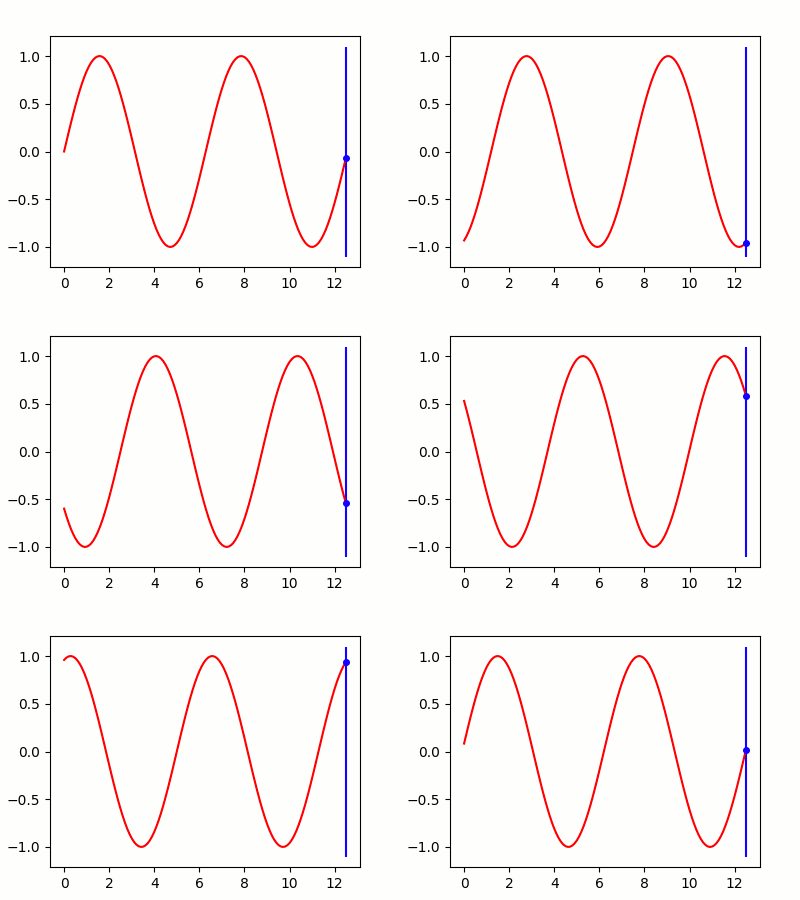
Because of the different distances between eye and screen, we end up in different points in the wire-gap pattern. I had trouble modeling those differing phases, and I suspect I've made an error somewhere, but the phase relation I get is

where the blue curve is the closer screen, and the red the more distant. That leads to a brightness pattern which looks like

While this does show brighter and darker patches, it seems to bear no resemblance to the type of pattern seen in quantum mechanics. I'm also not confident I have this correct, but I already spent too much time on debugging, so this will have to be another post with an unsatisfying conclusion!

Sunday, September 13, 2020

Aunt Enna

We've still been busy moving in here in Florida, hence my long silence. Recently though we've been considering TV options, and I saw an opportunity to tie our search into a post! We'd prefer not to get cable, but we've been missing watching the morning news, and wondered if we could get it over broadcast. As is, our TV won't pick anything up, but the FCC says there should be some channels in our area. That made us consider getting an antenna to help reception.

I had a basic idea of how antennas worked – They transmit and receive electromagnetic waves, and they can be uni-directional, or omni-directional. What I wondered was how they achieve those qualities. It turns out there's a vast number of antenna designs, depending on what type of signal you want, whether you're sending or receiving, and how big it should be.

Before we get into that though, let's go over the principle of an antenna. Radio waves are a form of electromagnetic wave, meaning they consist of an oscillating electric and magnetic field. We want our antenna to translate between those fields and electric current. In the case of long, straight antennas, we use the electric field to do that:

As the electric field (red line) moves through the antenna (blue line) it makes the electrons in the antenna (blue dot) move up and down. This is an alternating current, which corresponds to the signal encoded in the wave.

Those classic rabbit-ear antennas have mostly been replaced by varieties of flat designs, like the one we're considering:

Amazon

I had hoped to get a straight answer on what's inside these, but it seems the designs vary between different models. They appear to be variations on the dipole antenna, which use two wires in opposite directions, but it works on the same principle as the long, straight antennas.

Before I found that teardown page, I was guessing they actually held small loop antennas. These are interesting, because rather than the electric part of the electromagnetic wave, they use the magnetic field to induce current in the loop. That means that the directions they're sensitive in are opposite those of an equivalent electric antenna.

Clearly there's been a lot of study put into designing antennas for different purposes, but with all the other stuff we have on our plate, we're going to try for the cheap one and hope for the best. I'll just be happy if it doesn't explode!