Pages

Sunday, September 27, 2020

Filtered Photons

Our backyard here in Florida has a lovely screened porch, and whenever I go out there with Lorna, I notice this interesting effect:


The pattern made by the two screens reminded me of an interference pattern, so familiar from quantum mechanics:
Wikipedia

This type of pattern is created by the electromagnetic waves from different sources cancelling each other out, but that's certainly not happening with our screen. Instead, the geometry of the situation leads to the gaps and wires of the mesh aligning in different ways. We can imagine looking through one screen at another moving horizontally:
As the wire from the moving screen passes through the gap of the stationary one, the amount of light is reduced, creating the darker regions seen in the photo. In this case, we're looking through the corner of two screens at right angles:
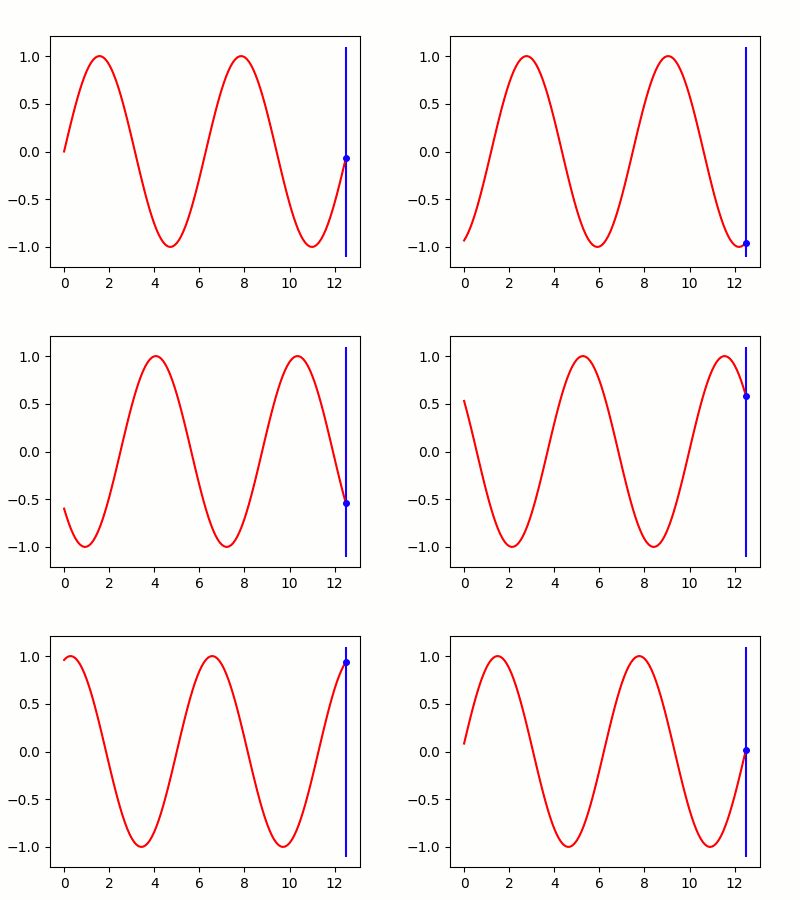
Because of the different distances between eye and screen, we end up in different points in the wire-gap pattern. I had trouble modeling those differing phases, and I suspect I've made an error somewhere, but the phase relation I get is

where the blue curve is the closer screen, and the red the more distant. That leads to a brightness pattern which looks like

While this does show brighter and darker patches, it seems to bear no resemblance to the type of pattern seen in quantum mechanics. I'm also not confident I have this correct, but I already spent too much time on debugging, so this will have to be another post with an unsatisfying conclusion!

Sunday, September 13, 2020

Aunt Enna

We've still been busy moving in here in Florida, hence my long silence. Recently though we've been considering TV options, and I saw an opportunity to tie our search into a post! We'd prefer not to get cable, but we've been missing watching the morning news, and wondered if we could get it over broadcast. As is, our TV won't pick anything up, but the FCC says there should be some channels in our area. That made us consider getting an antenna to help reception.

I had a basic idea of how antennas worked – They transmit and receive electromagnetic waves, and they can be uni-directional, or omni-directional. What I wondered was how they achieve those qualities. It turns out there's a vast number of antenna designs, depending on what type of signal you want, whether you're sending or receiving, and how big it should be.

Before we get into that though, let's go over the principle of an antenna. Radio waves are a form of electromagnetic wave, meaning they consist of an oscillating electric and magnetic field. We want our antenna to translate between those fields and electric current. In the case of long, straight antennas, we use the electric field to do that:

As the electric field (red line) moves through the antenna (blue line) it makes the electrons in the antenna (blue dot) move up and down. This is an alternating current, which corresponds to the signal encoded in the wave.

Those classic rabbit-ear antennas have mostly been replaced by varieties of flat designs, like the one we're considering:

Amazon

I had hoped to get a straight answer on what's inside these, but it seems the designs vary between different models. They appear to be variations on the dipole antenna, which use two wires in opposite directions, but it works on the same principle as the long, straight antennas.

Before I found that teardown page, I was guessing they actually held small loop antennas. These are interesting, because rather than the electric part of the electromagnetic wave, they use the magnetic field to induce current in the loop. That means that the directions they're sensitive in are opposite those of an equivalent electric antenna.

Clearly there's been a lot of study put into designing antennas for different purposes, but with all the other stuff we have on our plate, we're going to try for the cheap one and hope for the best. I'll just be happy if it doesn't explode!

Saturday, August 22, 2020

Itty Bitty Bang

 Another question this week from Papou: Since a Black Hole can continuously acquire mass (except those cases wherein it loses matter per S. Hawking), does it follow that those Black Hole’s Event Horizon is also continuously getting larger. If that were not the case and the Event Horizon continuously reduced its boundary, does it not follow that Black Hole would become a point mass followed by a Big Bang. If that were the case, then it would be irrational that there was only one Big Bang and we are the product of that singular Big Bang. It is more likely, then, that there may have been other Big Bangs and there are other Universes out in Space. Is there anywhere in space where the Red Shift is not consistent with our Big Bang; which would then imply that there may have been multiple Big Bangs.

I think you get my drift ..... basically I am saying:   “Can a Black Hole become a Big Bang? What is the latest Red Shift evidence?


There are a couple different issues at play here, so let's address them one by one. First off, the event horizon of a black hole: A black hole is a region of space where matter has become so dense, light cannot escape its gravitational pull. The size of that space, called the Schwartzschild radius, is proportional to the amount of mass inside it:
where G is the gravitational constant, M is the mass, and c is the speed of light. You can actually find this yourself by looking for when the escape velocity is equal to c. This radius is sometimes called the event horizon, since in Special Relativity, events are described as points in space and time that are observed through light. If light cannot escape the black hole, we cannot observe events within it.

That brings us to the next part of the question: What happens to a black hole over time? As the equation above states, the event horizon radius is directly proportional to the mass within it, so if it loses mass due to Hawking radiation, or gains mass due to objects falling it, the radius can shrink or grow, but for fixed mass, the event horizon should stay fixed. For small black holes, Hawking radiation can eventually reduce the mass to zero, which is believed to result in the black hole evaporating. As the black hole shrinks, it will cross between the theories of General Relativity, and Quantum Mechanics. In their current forms, these theories are incompatible, but it's believed the evaporating black hole would release a burst of gamma rays as it vanished.

Still, there is a connection between event horizons and big bangs: In 2013, a group of scientists proposed that our universe could exist as the event horizon of a black hole in 4 spacial dimensions. In our 3 spatial dimensions, an event horizon is the surface of a sphere, which is 2D. A 4 dimensional black hole though would result in a 3D event horizon. Of course, that implies the possibility of a 2D universe on the event horizons of our universe.

Finally, the connection to red shift: The universe is expanding at every point, which means every point is moving away from every other point. I often find it helpful to imagine a big rubber sheet being stretched outward; any two points drawn on the sheet will get farther apart. As light moves through the universe, its wavelength gets stretched too, making it "redder", i.e. lower frequency. If you point a radio telescope at an empty part of the sky, as Arno Penzias and Robert Wilson did in 1965, you'll find a constant signal in the microwave band of light, called the Cosmic Microwave Background (CMB). This light is distributed in the blackbody spectrum, the range of photons emitted by objects of a given temperature. That temperature is from 380,000 years after the Big Bang, when things had cooled enough for protons and electrons to combine into hydrogen, about 3000 Kelvin. Over the billions of years that light has travelled, it's been red shifted down to around 2.725 Kelvin, in the microwave range.

If you look at a picture of the CMB, you may notice that it's not entirely uniform:
NASA
These anisotropies are mainly due to gravity pulling particles into clumps, which cool differently. Some have suggested the CMB also contains evidence of "bruises" from collisions between our universe and others existing in a larger multiverse. However, no such collisions have been detected so far.

Thanks for another great question, Papou!