Pages

Sunday, January 21, 2024

The Fault in Our Ground

Yesterday, we took the camper to refill propane and get it cleaned. When we came back to our site, and plugged in to the campground power, we found nothing was flowing! We tried a couple ideas to solve it, but we were exhausted and it was already dark, so we turned up the (newly filled) propane heat and went to sleep. This morning, after much more troubleshooting, we discovered the issue was the ground fault circuit interrupter (GFCI), which we had tried the previous night, but hadn't performed the necessary reset steps correctly. I thought I'd get some good out of the frustrating experience, and write a post on GFCIs.

Humans are essentially big bags of salty water, which makes us good at conducting electricity. Unfortunately, letting anything more than around 100 milliamps flow through us can be fatal. The 120 volts that the US uses for mains power can create this much current under the right conditions, so we need safety mechanisms to prevent it.

A "ground fault" refers to the amount of outgoing current not matching the amount of current returning to the power source, meaning that charge is finding another path to flow down. We can measure the current in each line using a loop of wire, which picks up the magnetic field of the moving charges and generates a voltage in the loop. If the two lines don't match, we break the circuit:

In this diagram, the green loops measure the current, and the red is the GFCI's circuitry to compare and break the connections. Initially, I had wondered how a single outlet could cut power to all outlets, but this diagram makes that clear: Typically houses are wired with a pair of lines going from the source to some endpoint, and outlets are wired across the two in parallel. However, if we can break these lines immediately after the source, none of the downstream plugs will be powered.

That brings us to our issue: Once the GFCI is tripped, what do you do next? Typically, GFCIs have two buttons on them, Test and Reset. The test button will artificially pop the breakers so you can ensure they work, but critically, this requires having power. Once we had discovered the power wasn't working, we disconnected from the line in case whatever unknown problem was a fire risk. The real issue though was that to reset the GFCI, you need to push those breakers back in. They're designed to stop power within a tenth of a second, so they use powerful springs to open the connection quickly. That means you need to push a tiny button deep inside the outlet with incredible force, something we were incapable of doing last night! Thankfully in the morning we worked it out, and our power is back on without any expensive fix.

Sunday, January 14, 2024

Fraught Freight

Now that I'm actually going into an office every day, I'm once again a car commuter, and I'm filled with transportation-related questions! Our route mostly involves the highway, and I was curious about the rollover signs on off-ramps:

rxrsignals.com

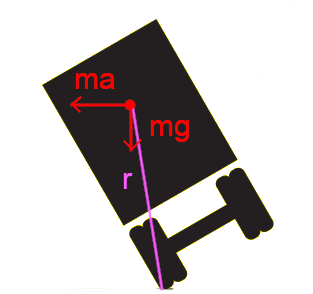
This shows a truck tilting at a 30° angle, while going 25 mph. The tilt comes from the fact that the truck is going around a curve, which requires applying a centripetal force. Since this force is applied to the tires, there's a torque produced, which will act to tip the truck toward the outside of the curve:

The red dot marks the truck's center of mass, with m the total mass of the truck, and a the acceleration required to make the turn. This is given by

where R is the radius of the turn. To find this, we can use Google Maps' measuring tool on the ramp by our home:

Given this R, along with the speed and dimensions of the truck, we can find the height of the center of mass that would produce the given tilt – The diagram above is too high, and the truck would tip over, but to balance g and a, we would need

where θ is the tilt angle. Using our 30° case, and the turn shown above, we can check the heights for several different speeds:

In most cases, we should expect the truck to be loaded such that the center of mass is in the center of the truck, which means the posted limit for our turn of 25 mph is just about right!

Sunday, December 17, 2023

Pneumatic Drop

Now that we're in Florida, and no longer sheltering from COVID, I've actually been working on campus. My department is in the (slow) process of moving to a new building, so I've been temporarily put in one of the large offices shared by grad students, and I've noticed an interesting quirk of my chair: After I get up, now and then it will sink to its lowest height, so I need to raise it again when I sit down. I was curious what was going on, and decided to look into how the lift mechanism works (or doesn't).

Most office chairs use a pneumatic cylinder to set and maintain a given height. They consist of a tube that can let air in or out when you open a valve, a piston connected to the chair, and a spring linking the tube to the piston:

We've defined a few variables here: L is the uncompressed length of the spring, i.e. the maximum height of the seat, hset is the height the chair is set to when the valve is closed, and h is the rest height. Using these, we can write the 3 forces acting on the seat:

where patm is the atmospheric pressure, A is the cross-section of the cylinder, k is the spring constant, m is the mass of the person on the chair, and g is the acceleration from gravity. If we set F = 0, we can get the rest state of the chair, and try a few values for the various quantities:

Here we've solved the above equation for h, and then plugged in a bunch of values for m and hset. I chose L to be 15 cm, A to be for a diameter of 5 cm, and set k so that 40 kg can compress the spring by L. The black lines show some constant values for the rest height, which gradually change slope depending on the set height. I decided to replot these points to better show the relationship between the set height and the rest height:

The dashed line shows points where the chair does not move from its set height – I was surprised to see so many points above the line, meaning the chair rises from its set point, but I'm thinking that's due to the spring strength I used, which may be way off.

As interesting as this was to work though, it doesn't bring me any closer to explaining why my chair drops while I'm not sitting on it, rather than rises. Time to write a grant proposal for "Pneumatic Posterior Support System Instabilities: Sources & Solutions"!